
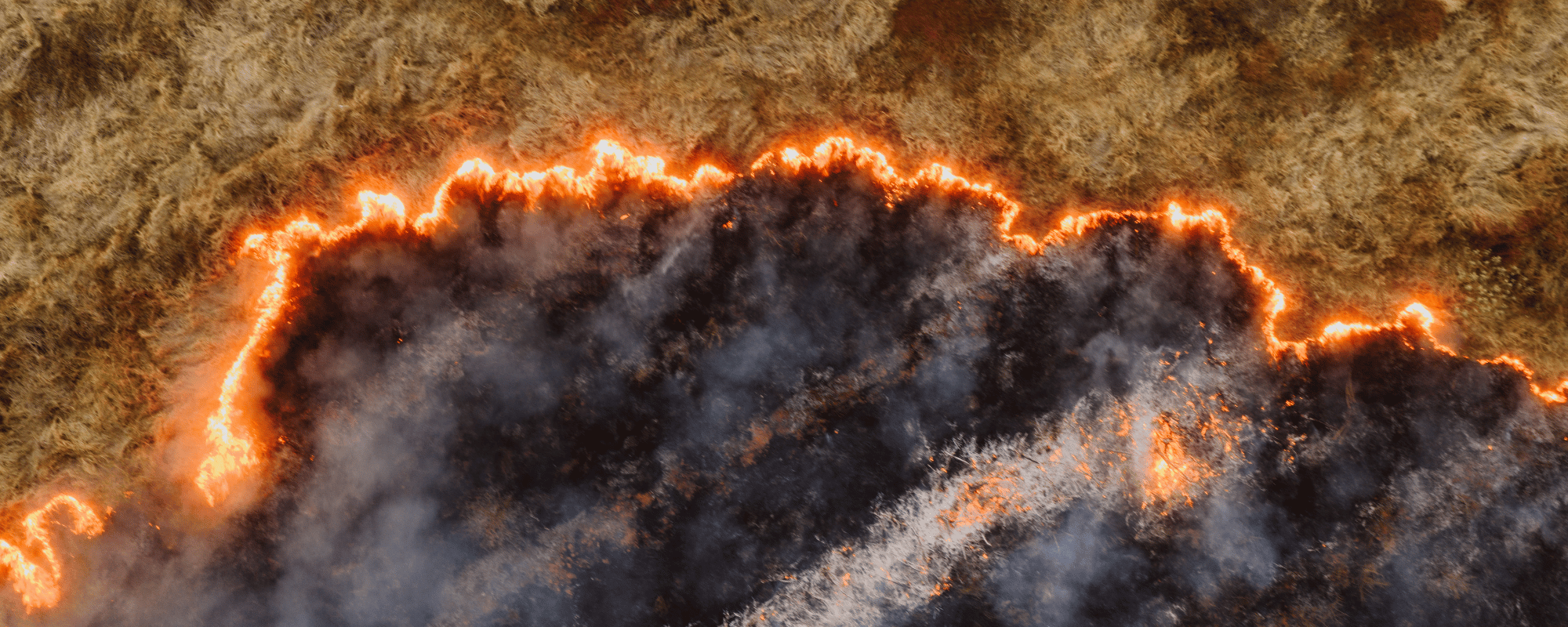
Irrefutable empirical scientific data, reinforced by observations of veteran firefighters and people on the land, confirm that a warming climate, proven to be caused by the burning of coal, oil and gas, is resulting in worsening and more frequent extreme weather events such as those that spawned the 2019-20 bushfires in NSW, Qld, SA, Victoria, WA and Tasmania. It is not possible to “adapt” to such catastrophic and escalating conditions, and they can only be partially mitigated.
The failure of successive governments at all levels to show leadership and take credible, urgent action on the basic causal factor: greenhouse gas emissions from the burning of coal, oil and gas, will lead to further escalation in natural disaster risks.
Emergency Leaders for Climate Action (ELCA) was formed in April 2019 due to deep shared concerns about the potential of the 2019-20 bushfire season, and unequivocal scientific evidence that climate change, driven mainly by the burning of coal, oil and gas, is worsening these extreme weather events, including hot days, heatwaves, heavy rainfall, coastal flooding, catastrophic bushfire weather and overlapping bushfire seasons..
In April and May 2019 ELCA corresponded with the Prime Minister and sought opportunities to brief him on the alarming potential of the looming bushfire season, then again later in 2019 when the catastrophic fire season, as warned, started to rapidly deteriorate. Ultimately after significant efforts to establish dialogue, a short meeting was held with Ministers Littleproud and Taylor on 4 December. By then hundreds of homes and a number of lives had already been lost in NSW and Queensland. No tangible changes or actions resulted from the December meeting, and further lives, together with hundreds of homes, were subsequently lost to the flames in NSW, Victoria and South Australia.
ELCA recommended a number of significant measures that would have aided state and territory firefighting efforts, including approval of additional funding previously requested by fire chiefs for additional large firefighting aircraft, and mobilisation of elements of the Australian Defence Force to logistically support emergency services and aid in initial recovery. The recommendations were initially ridiculed by politicians, then ignored, then belatedly implemented after public, political and media pressure, but not until after the worst damage and most deaths had already occurred. The sluggish response detracted from its effectiveness.
It could be argued that the measures recommended by ELCA, if implemented, could have helped to reduce losses. If this proposition is accepted, it may also then be inferred that the Australian Government was negligent and abrogated its responsibility to protect Australians by failing to listen to and act on information and advice offered by experts concerning an imminent emerging national disaster.
ELCA hopes that following this latest disaster, and given the inevitability of future escalating and catastrophic natural disasters because of past emissions, the Australian Government will learn from some state and territory governments, start to urgently develop and deploy meaningful climate change policies aimed at drastically and deeply reducing emissions, and in so doing, provide future generations with some prospect of withstanding or avoiding what is currently a nightmare scenario of natural disasters whose consequences will be of such a scale that they will not be able to be effectively mitigated against, adapted to, or responded to.
The costs of the current weak climate change policies and lack of sufficient action on emissions (in Australia and internationally) are becoming increasingly clear, and the moral culpability of this generation to future generations should also now be abundantly clear. Strong leadership on climate action is more necessary than ever before, because climate change is creating the conditions for more frequent ad deadly natural disasters.
ELCA has been heartened by the Australian Government’s response to the COVID-19 pandemic: in contrast to the bushfires, the Government listened to scientists and experts, consulted widely, communicated clearly, and acted quickly in the best interests of the country, coordinating actions with other nations. This needs to be the model for immediate action to start to stabilise, then ultimately reduce, unprecedented bushfire and natural disaster risks, driven by out-of-control emissions and climate change.
