
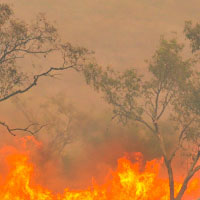
The world is at a critical juncture in history. Immediate, deep cuts to climate pollution are needed in order to try to stabilise global temperature increases by mid-century. Already Australia has experienced catastrophic emergencies exacerbated by the climate crisis, like the Black Summer fires. By mid century:
- The record extreme fire weather conditions that drove the Black Summer bushfire disaster which devastated communities all throughout Australia will constitute an “average” summer (Sanderson and Fisher 2020).
- Record-breaking floods will become more common because each degree of increased temperature enables the atmosphere to hold 7% more water, leading to more intense downpours, flash floods and riverine flooding (Bolan et al. 2024).
- Heatwaves, which kill more people than floods or bushfires, will be longer, hotter, and more common (Mason et al. 2022).
- Many communities will experience more days of hot weather, longer heat waves and more frequent and intense disasters, with the annual cost of disasters rising to an estimated $73 billion (Commonwealth of Australia 2024, Deloitte Access Economics 2021).
Emergency Leaders for Climate Action was founded in 2019 to ensure that former fire and emergency services chiefs could express their deep concerns about the worsening climate crisis to the government, in particular that Australian action to slash climate pollution was insufficient and too slow. Climate solutions are those that can slash climate pollution immediately and this must be the relentless focus of all governments.
In this submission we detail three critical concerns about current proposals to build nuclear power stations in Australia:
1. Nuclear power station emergency planning and management has not been considered in any plans for the development of nuclear energy generation in Australia.
- There are no safety or environmental frameworks in place to manage the risks of nuclear power stations in Australia (Macdonald-Smith, 2024).
- States and territories are responsible under the Australian Constitution for emergency management, but only one jurisdiction, NSW, has a minor capability, developed to deal with emergencies at the very small Lucas Heights research reactor.
- It is not clear whether states and territories would bear the entire cost of emergency planning and response to deal with potential emergencies and disasters resulting from the nuclear power stations and the transportation and storage of radioactive waste.
2. Building nuclear reactors in Australia will be too slow to be a genuine climate solution.
- Australia is experiencing more frequent and ferocious extreme weather events as a consequence of the climate crisis (Commonwealth of Australia, 2024). Most Australians have already experienced harm from these events and Australia’s emergency service personnel are operating in increasingly unpredictable and dangerous conditions (Climate Council 2024).
- It is abundantly clear that climate pollution from the burning of fossil fuels must be slashed this decade and the next to protect Australia (Climate Council 2021).
- Indications are that nuclear reactors would be very unlikely to come online in Australia until the 2040s, way too late to contribute realistically to tackling the urgent climate crisis that we already face.
- If the Australian government pursues nuclear power stations in earnest it could delay or stymie genuine climate solutions like renewable power and storage projects that can be established now. Nuclear power stations are therefore a distraction from the urgent task of moving our power system to clean energy. Any delays to the necessary build out of clean power, like renewables and storage, will result in more dangerous climate pollution continuing to be produced at high levels, driving further increases in disasters.
3. Australia’s emergency services are neither trained nor funded to respond to nuclear disasters, both at nuclear power plants or during transport of radioactive waste.
- International experience shows that full time firefighters from urban fire and rescue services will be required to be first responders to emergencies at nuclear reactors. At present Australian emergency services are ill-equipped to do so.
- Civilian fire services were called in during the early stages of nuclear disasters at Chernobyl and Fukushima when onsite operators were overwhelmed by emergencies involving overheating, failure of water supplies and pumps used for cooling, and dangerous escapes and spillages (IAEA 2024b, BBC 2023, Funabashi & Kitazawa 2012).
- Should this situation arise in Australia, firefighters will be expected to put their lives on the line, as occurred in the response to the Fukushima nuclear disaster and risk losing them, as occurred in Chernobyl (IAEA, 2024a).
- There are currently no fully staffed urban fire service stations situated in locations proposed to host nuclear power stations, and it is neither feasible nor reasonable to expect volunteer bushfire fighters to be first responders to nuclear emergencies and disasters.
Australia must be focused on the urgent task of slashing climate pollution, including from our energy system. Worsening extreme weather has been experienced now by most Australians (Climate Council 2024) and has made responding to disasters even more dangerous for emergency personnel.
Nuclear power stations simply cannot be built quickly enough to address the urgent task of slashing pollution. We cannot wait decades for new power stations, we need to slash climate pollution now to protect Australians. We already have cheaper, simpler solutions like renewable power which are available and are already being used extensively in Australia. We are concerned that a decision to establish a very costly nuclear power industry would stymie, rather than drive, true and immediate climate action.
ELCA also has a number of key additional concerns about the safety of emergency services and the total lack of thought given to the significant requirements to fund and prepare emergency services to deal with potential disasters from an Australian nuclear industry. This is complex and costly work and should be considered extensively, particularly in light of worsening extreme weather events which are increasingly taxing existing emergency management and response systems.
Australia would be far safer and far better prepared for worsening extremes if the tens of billions of taxpayer dollars required for building nuclear power stations were instead invested in renewable power, transmission infrastructure, storage like pumped hydro and big batteries, community resilience projects and emergency preparation and response – as per current plans.
Australia cannot afford to waste any further time on proposals to develop nuclear power stations that are likely to delay urgent climate action therefore causing further harm to Australians.
